
Atherosclerosis: Emerging Approaches for Reducing Cardiovascular Disease
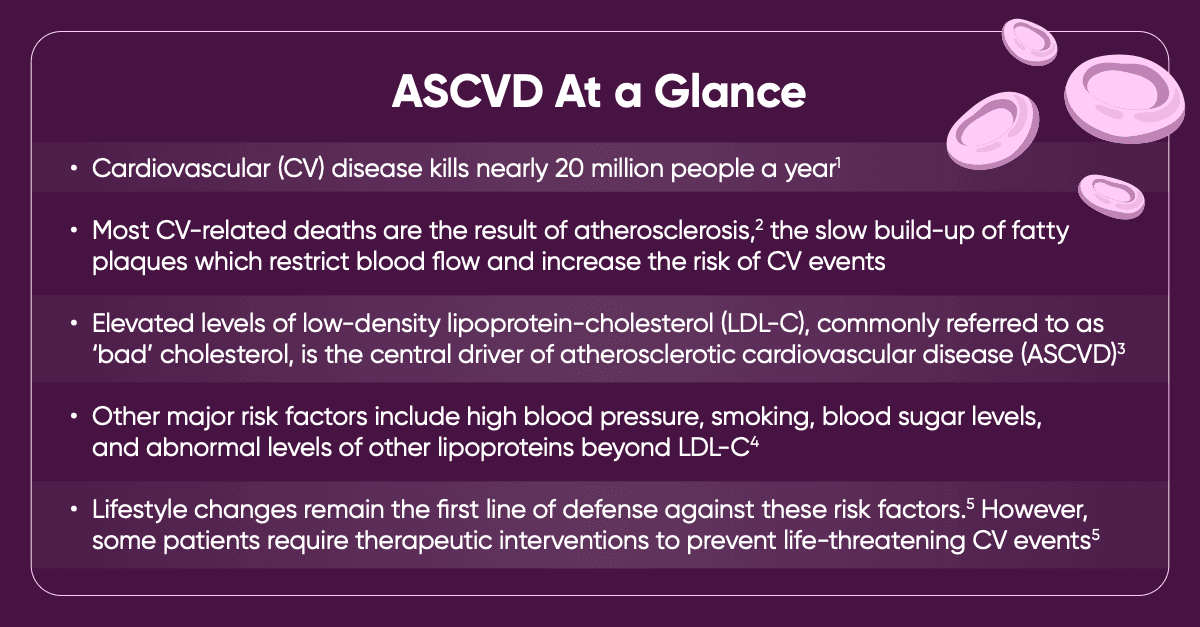
Despite over 50 years of research, ASCVD remains the leading cause of mortality worldwide and is associated with a huge economic burden (0.7% of global GDP, to be exact).6,7 Worryingly, prevalence continues to rise, particularly in those aged under 50.7,8 The continued challenge of ASCVD has prompted the development of a range of therapies over the years, from statins through to genomic based medicines.
How did statins revolutionize ASCVD treatment?
In the late 20th century, researchers developed a new class of medications called statins, which lower LDL-C by blocking a liver enzyme involved in cholesterol production.9 Since the first statin became commercially available in 1987, CV deaths from heart disease have practically halved in the US, dropping from 321.8 per 100,000 people in 1990 to 161.5 in 2019.9
Statins have been prescribed to hundreds of millions of people and remain the cornerstone therapy for managing lipid cholesterol.10 However, statins have been associated with a range of adverse effects, including muscle symptoms, impaired glucose homeostasis and potentially an increased risk of new-onset type 2 diabetes.11 Furthermore, up to 40% of those on statins go on to have CV events, revealing a persistent ‘residual risk’. Together, these safety concerns and limitations prompted new approaches to reducing CV risk.12
What other therapeutic targets lower ‘bad’ cholesterol?
Advances in pharmacology combined with a deeper understanding of atherosclerosis have led to the discovery of other disease-modifying targets. One of the most well-known is proprotein convertase subtilisin/kexin type 9 (PCSK9), a protein that triggers the degradation of LDL-C receptors and reduces uptake of LDL-C from blood.12
The activity of PCSK9 can be altered, both within and outside the cell. Monoclonal antibodies that directly bind circulating PCSK9 can reduce LDL-C levels by up to 60%, or potentially more when combined with other drugs.12
A different strategy for inhibiting PCSK9 is through RNA therapeutics, which silence expression of PCSK9. Clinical trials have found this approach to be effective at lowering LDL-C levels, and an injectable RNA therapy recently been approved.12
Individuals who carry natural loss-of-function mutations in the gene encoding PCSK9 are 88% less likely to develop coronary artery disease.13 It is possible to edit genes directly to replicate that protective effect. Gene-editing therapies targeting PCSK9 are currently under investigation and could potentially provide high-risk patients with lifelong protection from a single treatment.8 While initial results are promising, these therapies are in early-phase clinical trials, and their long-term safety is still being evaluated.12
This approach of inhibiting a therapeutic target at the protein, RNA, and genetic level is also being pursued for other molecules involved in the LDL-C pathway. This includes the proteins ANGPTL3 (short for Angiopoietin-like protein 3) and CETP (short for Cholesteryl Ester Transfer Protein), which have both been shown to reduce LDL-C and alter the ratio of other lipids.12
A monoclonal antibody against ANGPTL3 is already clinically available, and RNA therapeutics are in the research pipeline.12 While clinical trials of CETP inhibitors have shown limited benefit9, new CETP-targeting treatments, which place greater emphasis on LDL-C lowering, may show more promise.14

Is LDL-C lowering the only option to reduce the risk of ASCVD?
While lowering LDL-C remains the primary strategy, researchers have identified other therapeutic targets that could help reduce CV residual risk.
Around 20% of the population are predicted to have elevated levels of lipoprotein Lp(a), which has been shown to be a causal risk factor for ASCVD and is increasingly being incorporated into CV risk assessments.15 Different approaches to reducing Lp(a) are under investigation.15,16 While these approaches can reduce Lp(a) levels by 80–90%, an impact on CV outcomes has not yet been reported.15
Triglyceride lipids have also been shown to increase CV residual risk in patients on LDL-lowering therapies.15 Yet, despite compelling evidence, therapies targeting triglycerides have been largely unsuccessful in clinical trials.15
Treatment targets beyond lipids
Lipid-related factors are not the only new targets being investigated. Even with traditional risk factors like cholesterol under control, up to 60% of ASCVD patients still show elevated levels of an inflammatory marker.17 Some anti-inflammatory drugs have been found to be effective in clinical trials, and one has been approved for clinical use.15 However, the widespread adoption of this approved therapy has been limited, and its clinical benefit continues to be hotly debated.18,19
New research suggests that incretin-based drugs can also lower the risk of CV events, independently from their role in weight loss.20 The American College of Cardiology (ACC) now recommends offering offering incretin-based medications alongside lifestyle changes, rather than requiring patients to try and fail lifestyle measures first.21
Other novel risk factors for ASCVD are also emerging, including the gut microbiota and clonal hematopoiesis (age-related mutations in blood stem cells).15 While drugs targeting these mechanisms are not yet available, investigations into their role in ASCVD and how they could be therapeutically targeted is an active and growing area of interest.
It’s also important to note that LDL-C goals set out by clinical guidelines have become increasingly stringent over recent years, and many patients are unable to meet these targets with statin therapy alone.22 Combination therapy, therefore, is becoming more common, further highlighting the need for effective and well-tolerated treatment options to achieve optimal lipid control and reduce residual CV risk.22
What does the future hold?
The number of ASCVD therapies has grown significantly over the past decade. New drugs, however, do not always translate into changes in clinical practice, and wider education on available treatment options may be needed.
These advances combined with new risk assessments have the potential to transform the ASCVD treatment landscape and trigger a second revolution equivalent to the arrival of statins.
References
- World Health Organization. Cardiovascular diseases (CVDs). World Health Organization. Updated July 31, 2025. Accessed July 21, 2026. https://www.who.int/news-room/fact-sheets/detail/cardiovascular-diseases-(cvds)
- Nedkoff L, et al. Clin Ther. 2023;45(11):1087–91.
- Du Z, Qin Y. J Clin Med. 2023;12(1):363.
- Grundy SM, et al. J Am Coll Cardiol. 2019;73(24):e285–e350.
- Arnett DK, et al. Circulation. 2019;140(11):e596–e646.
- Mahmood T, Shapiro MS. Methodist Debakey Cardiovasc J. 2021. 24;17(4):8–14.
- Bray G., Darrow B., Skedgel C. The burden of LDL-cholesterol-driven atherosclerotic cardiovascular diseases (2026). Contract Research. Available from https://www.ohe.org/publications/the-burden-of-ldl-cholesterol-driven-atherosclerotic-cardiovascular-diseases/.
- King SJ. Am J Prev Cardiol. 2024;19:100779.
- American Chemical Society. Statins: Revolutionizing Cardiovascular Medicine. American Chemical Society. Accessed July 21, 2026. https://www.acs.org/education/whatischemistry/landmarks/merck.html.
- Harrington RA. JAMA Cardiol. 2017;2(1):66.
- Khatiwada N, Hong Z. Pharmaceutics. 2024;16(2):214.
- Agnello F. J Clin Med. 2024;13(5):1251.
- Katzmann JL, et al. Metabolites. 2022;12(1):70.
- Chang B, et al. Curr Atheroscler Rep. 2024;26(10):603–8.
- Zheng WC, et al. Eur Heart J Cardiovasc Pharmacother. 2024;10(1):53–67.
- Alhomoud IS. Front Med. 2025;12:1727918.
- Mazhar F, et al. Eur Heart J Open. 2026;6(2):oeag023.
- Khorsandi M, et al. Am Heart J. 2025;279:76–80.
- O’Riordin. No Clarity on Colchicine: Two Meta-analyses Spark Debate on Drug’s Merits. tctMD. Accessed August 18, 2026 https://www.tctmd.com/news/no-clarity-colchicine-two-meta-analyses-spark-debate-drugs-merits.
- Deanfield J, et al. Lancet. 2025;406(10516):2257–68.
- American College of Cardiology. American College of Cardiology issues guidance on weight management drugs. American College of Cardiology. Published June 20, 2025. Accessed July 21, 2026. https://www.acc.org/about-acc/press-releases/2025/06/20/14/11/american-college-of-cardiology-issues-guidance-on-weight-management-drugs.
- Mach F, et al. Eur Heart J. 2025;46(42):4359–78.
- Ray KK, et al. Eur J Prev Cardiol. 2021;28(11):1279–78.